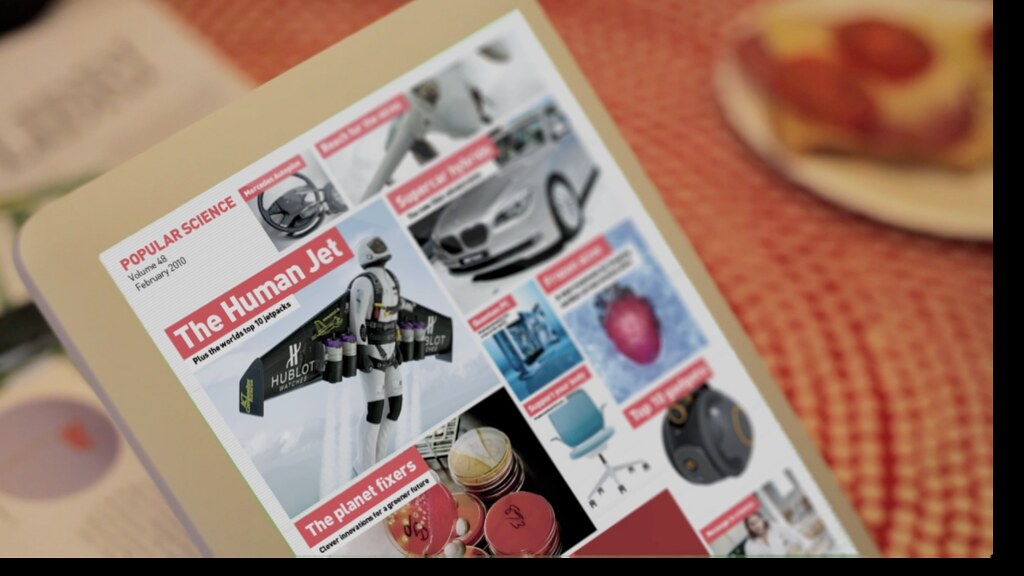
Mag+ was an approach for bringing paper magazines to digital media, with a special focus on the touchscreen tablets we could all see coming.
Team: Jack Schulze, Matt Webb, Timo Arnall, Campbell Orme, Nick Ludlam, James Darling, Lei Bramley, Phil Gyford, Tom Armitage and Tom Taylor.
BERG began working with Bonnier R&D in October 2009 on what reading a magazine on a tablet might feel like. We made a video prototype that December — a month before the iPad was even announced — to think the experience through as a piece of film rather than a spec. When Apple revealed the device on 27 January 2010, we had a head start, and raced to build it for real. Popular Science+ launched on 3 April 2010, the day the iPad went on sale in the US.
Five principles
Underneath the work were five ideas about what a digital magazine should protect from the world of apps and browsers:
- A magazine is mono-task — a calm, single thing to do, so we gave it a ‘silent mode’ away from notifications and the open web.
- An issue has a clear structure — a beginning, middle and end you can feel.
- Reading is built on fluid motion — direct, gestural, never modal.
- It should be comfortable to read for a long time.
- And it should feel like one thing, not a pile of separate articles.
Thinking through making
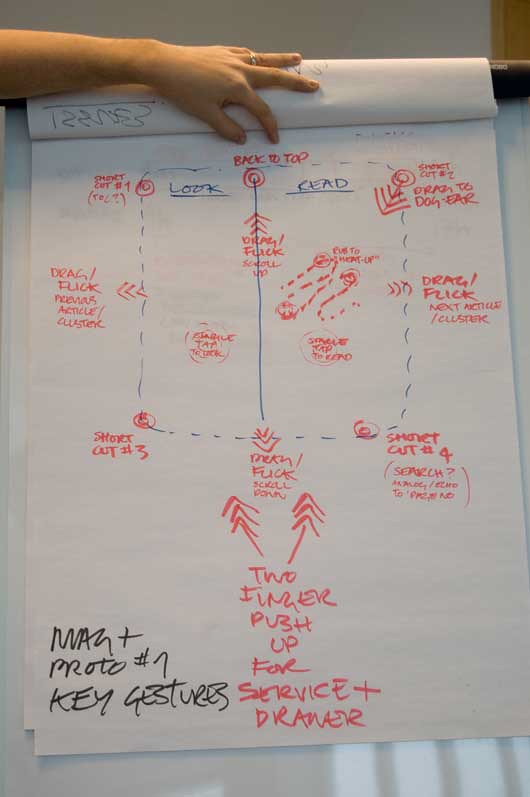
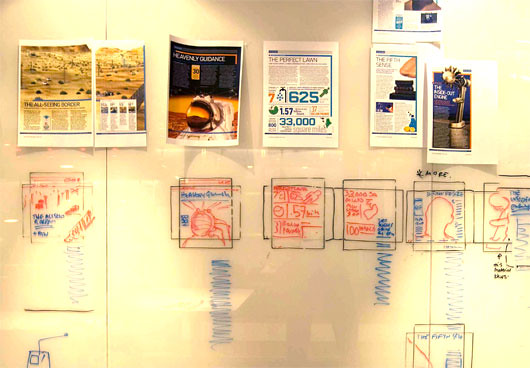
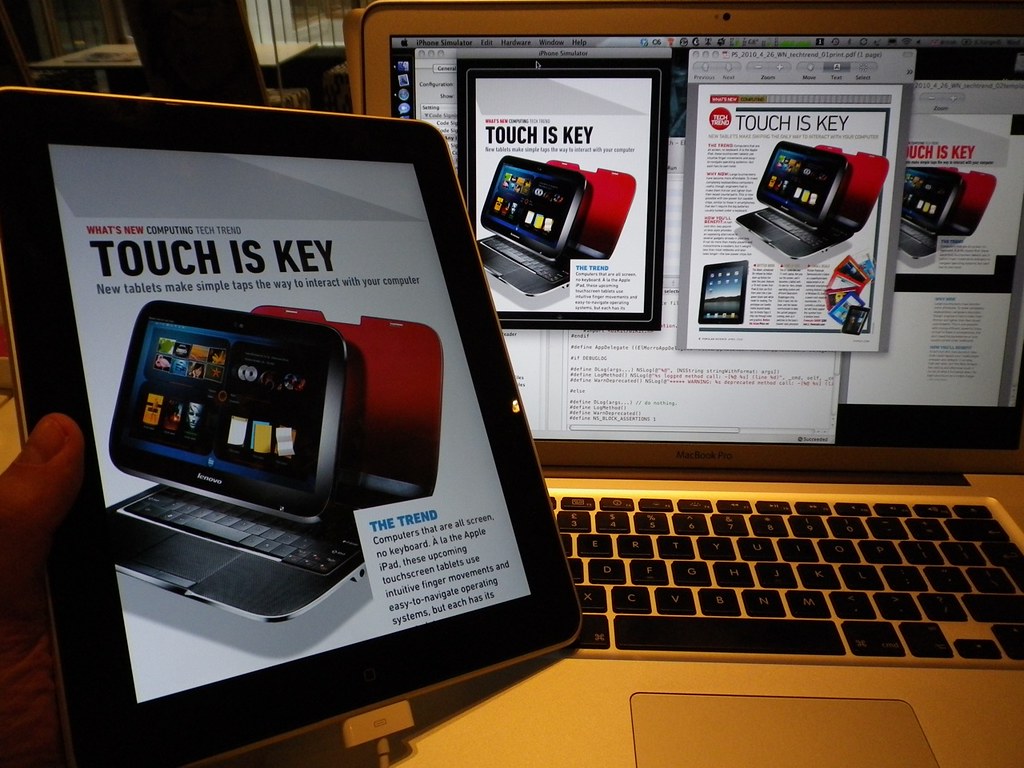
We worked fast and physically: taping up pieces of real magazines and filming them with an iPhone to test layouts at full size; making video prototypes with live-action footage; and mapping every interaction as a gesture before writing a line of code.
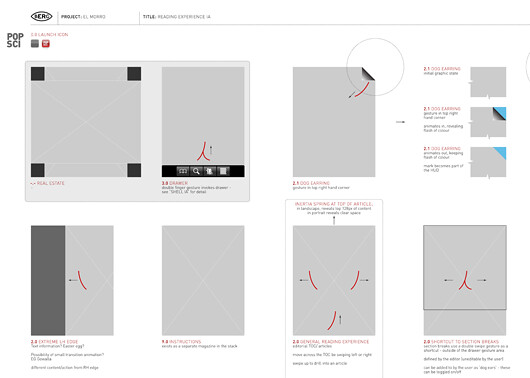
To make it real and repeatable we built an authoring system, tools that flowed straight out of InDesign, an e-commerce back end, and a new file format (‘MIB’) for issues.
Steve Jobs liked it
When Apple showed off what the iPad could do, Steve Jobs singled out Popular Science+ — built on Mag+ — as an example of the kind of reading experience the device made possible. Praise from an unexpected quarter for a tiny London studio.
Mag+ went on to spin out of BERG as a publishing platform in its own right — but the part I remember is how much of the future we got to feel out, on paper and on film, before the hardware to run it even existed.